Learn how to cut your own hair with these 10 beginner-friendly steps. Avoid common disasters while achieving amazing results – perfect for men, women and all hair types in 2025!
How to Cut Your Own Hair – 10 Steps to Avoid Disasters and Achieve Amazing Results
Cutting your own hair can feel intimidating – one wrong snip and you’re stuck with a bad haircut for weeks. But with the right approach, it’s empowering, saves money (£30–£80 per salon visit) and gives you control over your style. Searches for “how to cut your own hair” exploded in 2025 as more people embraced DIY grooming amid busy schedules and rising costs.
This guide focuses on safe, simple techniques for basic trims, layers and men’s fades. Whether you’re tidying split ends or bold enough for a full cut, these steps help you avoid disasters and get amazing results.
Let’s transform fear into confidence!
Why Cut Your Own Hair in 2025
- Huge savings – Professional cuts add up fast
- Convenience – No appointments needed
- Customisation – Exact length/style you want
- Skill building – Gets easier with practice
Most beginners see great results after 1–2 tries.
Preparation: Tools & Setup
Invest in quality tool:
- Sharp hairdressing scissors (£10–£30)
- Fine-tooth comb
- Sectioning clips
- Hand mirror + large mirror
- Cape or old towel
Set up in bright light. Wet or dry? Wet for straight cuts, dry for textured/layers.
Step 1: Start with Clean, Dry (or Damp) Hair
Wash and condition first. For straight cuts, dampen slightly. Dry styling lets you see true length.
Section hair to avoid uneven mistakes.
Step 2: Decide Your Goal & Cut Conservatively
Trim? Layers? Bangs? Men’s fade?
Rule: Cut less than you think – You can always take more, but not add back.
Beginners: Start with 1–2cm trim.
Step 3: Section Hair Properly
Divide into 4–6 sections:
- Top, sides, back, bangs (if any)
- Clip away what you’re not cutting.
Work one section at a time – Prevents disasters.
Step 4: Master Basic Trim Technique
- Comb straight down.
- Hold between fingers at desired length.
- Cut below fingers in straight line.
- Check both sides for evenness.
Point cutting (snip vertically) softens ends.
Step 5: Add Layers (For Movement)
- Elevate sections at 90° angle.
- Cut shorter on top, longer underneath.
- Connect layers smoothly.
YouTube tutorials help visualise.
Step 6: Cut Bangs Carefully
- Section front hair.
- Cut middle first, then sides.
- Slightly longer to shorter for face-framing.
Mistake fix: Grow out or pin back.
Step 7: Men’s Cuts – Buzz or Fade Basics
- Clippers with guards for even length.
- Start longer guard, go shorter gradually.
- Fade: Blend guards from bottom up.
Neckline: Mirror + freehand.
Step 8: Check & Fix Uneven Areas
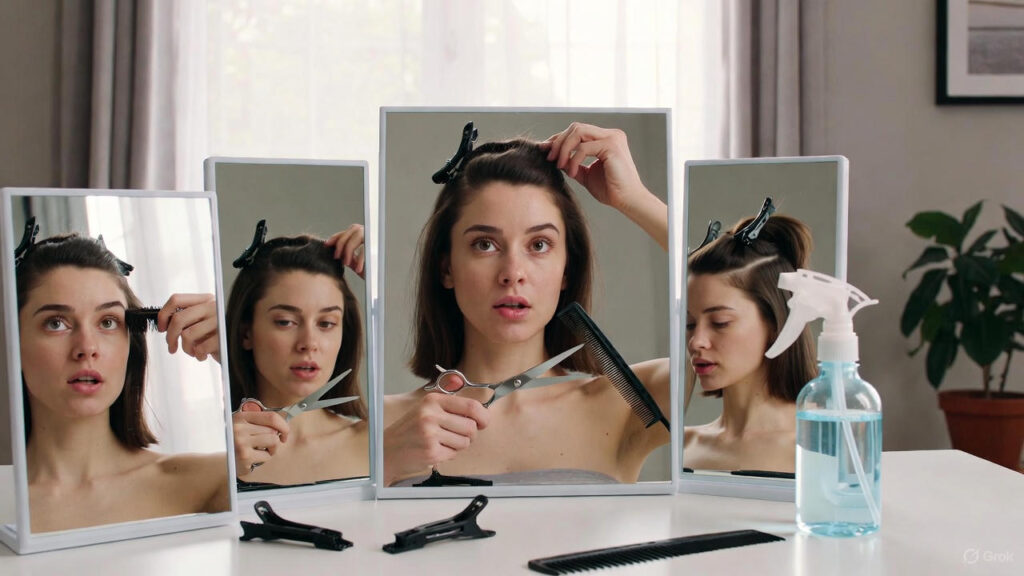
Use two mirrors for back view.
Trim tiny bits to even out – Rushing causes disasters.
Step 9: Style & Assess
Blow dry/style normally.
Still uneven? Wait a day – Hair settles.
Step 10: Maintain & Improve
- Trim every 6–8 weeks.
- Watch tutorials for your hair type.
- Invest in better tools as confidence grows.
Common Mistakes & How to Avoid Disasters
- Cutting too much – Always underestimate.
- Blunt horizontal cuts – Point cut for natural look.
- Ignoring hair texture – Curly needs different approach.
- Poor lighting – Natural daylight best.
Frequently Asked Questions (FAQ)
Q: Best scissors for cutting your own hair?
A: Professional hair shears – Never kitchen scissors.
Q: Curly hair tips?
A: Cut dry, in natural curls.
Q: How short first time?
A: 1–2cm max – Build confidence.
Q: Fix bad self-cut?
A: Hats, clips, or professional rescue.
Q: For kids?
A: Simple trims only – Or professional.
Final Thoughts
Cutting your own hair shifts from scary to satisfying once you master basics. These steps help you avoid disasters while achieving amazing, personalised results that save time and money.
Start small, practice patience and remember – hair grows back! With each cut, you’ll gain skill and confidence.
Your next haircut is in your hands – make it amazing! ✂️