
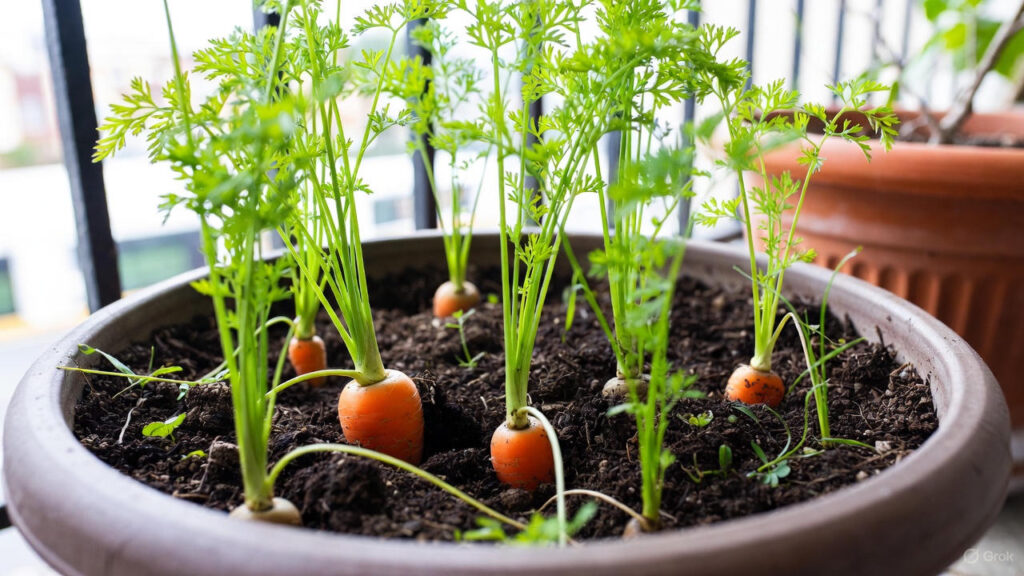
Learn how to grow carrots in containers with our easy 7-step UK guide. Perfect for balconies & beginners. Enjoy sweet, straight carrots without carrot fly worries!
How to Grow Carrots in Containers
Want sweet, crunchy carrots straight from your patio or balcony? Learning how to grow carrots in containers is one of the simplest and most rewarding projects for UK gardeners. It saves space, keeps carrot fly at bay, and gives you complete control over the soil. Whether you have a tiny courtyard, a flat roof, or just a sunny windowsill, this method works brilliantly. Follow this friendly guide and you will be pulling perfect carrots in as little as 10 weeks.
Why Containers Are Perfect for Carrots in the UK
Growing carrots in the ground can be tricky because heavy soil makes roots fork and carrot fly loves open beds. Containers solve both problems. You use light, fluffy compost that encourages straight growth, and raising the pot 30-45 cm off the ground puts it out of reach of low-flying carrot flies. Thousands of British gardeners now swear by this technique every year.
What You Will Need
Before diving in, gather some basics to support your journey.
- Deep containers (minimum 30 cm, ideally 40-45 cm) with drainage holes
- Multi-purpose or vegetable compost mixed with a handful of horticultural sand or grit
- Carrot seed varieties suited to containers (e.g. ‘Nantes’, ‘Amsterdam Forcing’, ‘Chantenay Red Cored’, or round types like ‘Paris Market’)
- Watering can with a fine rose
- Fine insect mesh or horticultural fleece (optional but recommended)
- Liquid seaweed feed or tomato fertiliser
How to Grow Carrots in Containers: 7 Easy Step-by-Step Instructions
Step 1: Choose and prepare your container
Start in March or April for a summer crop, or sow until July for autumn harvests. Drill extra drainage holes if needed and stand the pot on feet or bricks to improve airflow.
Step 2: Fill with the right compost
Fill to within 3 cm of the rim with a 50/50 mix of peat-free multi-purpose compost and fine horticultural sand or grit. This keeps the mix loose and free-draining.
Step 3: Sow the seed thinly
Scatter seed very sparingly across the surface (roughly 50-60 seeds per 30 cm pot). Cover with just 5-10 mm of sieved compost. Water gently with a fine rose.
Step 4: Keep moist and warm
Place in a sunny spot and cover with a sheet of glass or clear plastic until germination (14-21 days). Never let the surface dry out completely.
Step 5: Thin the seedlings twice
First thinning: when seedlings are 2-3 cm tall, thin to 2-3 cm apart. Second thinning: at 5-7 cm tall, thin to 5-7 cm apart. Use scissors to snip tops rather than pulling to avoid disturbing neighbours.
Step 6: Water and feed wisely
Water little and often to keep compost evenly moist. Start liquid feeding with tomato fertiliser once a fortnight after the second thinning.
Step 7: Harvest and enjoy
Baby carrots are ready from 8 weeks; maincrop from 10-12 weeks. Gently twist and pull, or tip the pot out for the final harvest.
Handy Tips for Success
- Raise pots off the ground to deter carrot fly.
- Cover with enviromesh from May to August for extra protection.
- Successional sow every 3 weeks for a constant supply.
- Avoid fresh manure or high-nitrogen feed; it causes hairy, forked roots.
There you have it: everything you need to know about how to grow carrots in containers. Give it a try this season and taste the difference home-grown makes!
FAQ
Q: When is the best time to start growing carrots in containers?
A: March to July in the UK. Early sowings need a sunny windowsill or cold frame.
Q: Why are my container carrots forked or twisted?
A: Usually because the compost was too heavy or contained stones. Always use a sandy mix.
Q: Can I reuse the compost next year?
A: Yes, but top it up with fresh compost and a handful of sand.
Q: How many carrots will one large pot produce?
A: A 40 cm pot typically yields 30-40 good-sized carrots.
Q: Do carrots in containers need full sun?
A: They prefer 6+ hours of direct sun, but light shade in the afternoon is fine.