Master how to make French macarons with this easy UK baking guide. Get expert tips on whipping meringue, macaronage, and getting perfect feet every time.
How to Make French Macarons
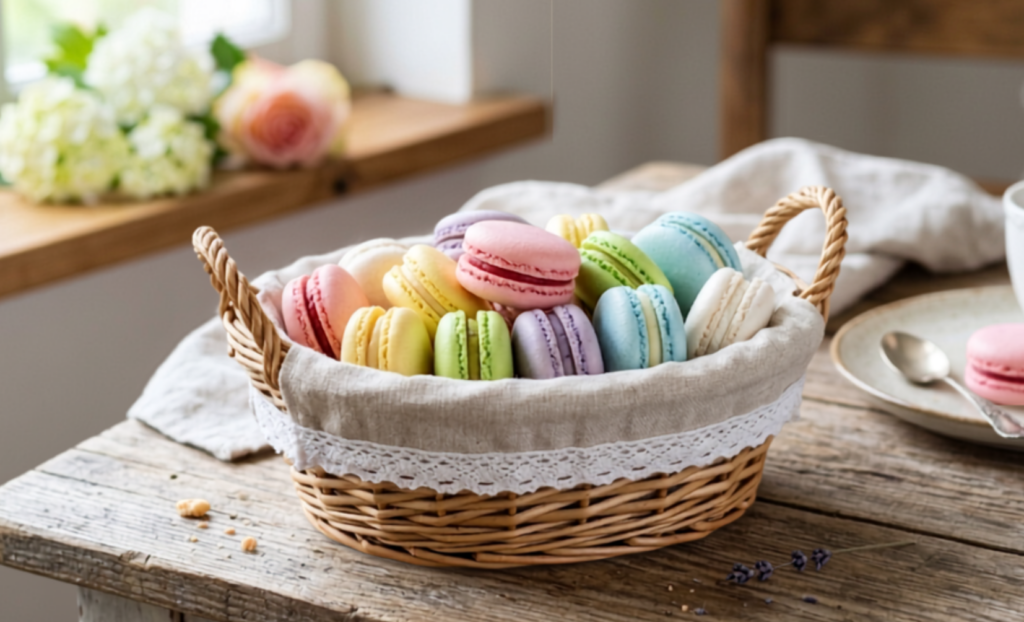
Few patisserie treats capture hearts quite like delicate French macarons. With their glossy, smooth tops, frilly “feet” around the base, and melt-in-your-mouth chewy interiors, these colourful little gems are as stunning to look at as they are delicious to eat. While they have a reputation for being notoriously temperamental, learning how to make French macarons at home is entirely achievable with the right technique, a touch of patience, and precise measurements.
Unlike simple biscuits, French macarons rely on a delicate meringue structure and a specific folding technique known as macaronage. You do not need professional pastry chef skills to master them; you just need to follow a clear, methodical process. This step-by-step guide walks you through every stage, ensuring your homemade macarons turn out beautifully on your very first try.
1. Gather and Weigh Your Ingredients Precisely
Precision is everything when discovering how to make French macarons. Using volume cups can lead to inconsistent results, so using a digital kitchen scale is essential for achieving accurate ratios.
Prepare these core components using exact weights:
- Finely ground blanched almond flour: Measure out 100g of blanched almond flour (or ground almonds) for a smooth, bump-free shell surface.
- Icing sugar: Measure 100g of icing sugar to sweeten and thicken the dry mixture.
- Egg whites: Separate 100g of egg whites (from roughly 3 medium eggs) at room temperature, making sure no yolk enters the bowl.
- Caster sugar: Measure 100g of fine caster sugar to build a stable, glossy French meringue.
2. Sift and Blend the Dry Ingredients
Eliminating large lumps is a crucial structural step when learning how to make French macarons. Coarse almond pieces will ruin the sleek, smooth finish of your baked shells.
Prepare your dry mixture using these simple steps:
- Pulse in a food processor: Place the almond flour and icing sugar into a food processor and pulse for 10 to 15 seconds to combine them into an ultra-fine powder.
- Sift twice through a fine mesh sieve: Pass the blended mixture through a sieve into a clean bowl to remove any remaining coarse almond bits.
- Discard large remnants: Set aside any leftover large pieces caught in the sieve rather than forcing them through, ensuring your batter stays silky.
3. Whip the French Meringue to Stiff Peaks
Creating a sturdy meringue foundation is a key technical detail when researching how to make French macarons. A weak meringue will cause the shells to spread flat or crack in the oven.
Follow this method to whip your egg whites correctly:
- Ensure grease-free equipment: Wipe down your glass or stainless steel mixing bowl with a splash of lemon juice to remove lingering oils.
- Whisk until foamy: Beat the room-temperature egg whites on medium speed using an electric hand mixer or stand mixer until soft, foamy bubbles appear.
- Add caster sugar gradually: Slowly add the 100g of caster sugar one tablespoon at a time while continuing to whisk until the sugar dissolves.
- Whip to glossy stiff peaks: Continue beating until the meringue forms tight, glossy peaks that hold their shape firmly when you lift the whisk. Add a drop of gel food colouring at this stage if desired.
Properly whipping your meringue base when mastering how to make French macarons guarantees your shells hold their rise during baking.
4. Master the Macaronage Folding Technique
Combining the dry ingredients with your meringue requires gentle control. This crucial folding process, known as macaronage, knocks out just enough air to yield the ideal batter texture when exploring how to make French macarons.
Achieve the perfect consistency using these guidelines:
- Add dry ingredients in batches: Sift half of the almond mixture over the meringue and gently fold with a silicone spatula using a sweep-and-cut motion around the bowl.
- Incorporate the remaining half: Sift in the remaining dry mixture and continue folding gently.
- Test for the figure-eight flow: Stop mixing as soon as the batter flows off your spatula like warm lava. You should be able to draw a figure-eight pattern with the falling batter without it breaking.
5. Pipe the Batter and Tap Out Air Bubbles
Shaping your macarons requires a steady hand and proper baking equipment, making this a vital practical step when learning how to make French macarons.
Pipe your rounds using these instructions:
- Prepare your baking tray: Line a flat baking sheet with greaseproof baking paper or a silicone baking mat.
- Fill your piping bag: Transfer the batter into a piping bag fitted with a plain 1cm round nozzle.
- Pipe uniform rounds: Hold the bag vertically and pipe 3cm circles onto the sheet, leaving a 2cm gap between each round.
- Tap the tray firmly: Firmly tap the baking tray on your kitchen counter three or four times to force trapped air bubbles to the surface, popping any visible bubbles with a toothpick.
6. Rest the Shells and Bake Until Golden
Allowing your piped batter to rest on the counter is the secret to developing those classic frilly bases when mastering how to make French macarons.
Complete the baking process using these timing steps:
- Rest at room temperature: Leave the piped shells to air-dry for 30 to 45 minutes until a dry skin forms on top. The surface should no longer feel sticky when touched gently with a finger.
- Preheat your oven: Heat your oven to 150°C (130°C fan or Gas Mark 2).
- Bake on the middle shelf: Bake the macarons for 14 to 16 minutes. They are ready when the tops are firm and the signature frilly feet have formed around the bottom.
- Cool completely: Allow the shells to cool entirely on the baking tray before gently peeling them off.
Frequently Asked Questions
Bakers frequently ask these practical questions when learning how to make French macarons.
1. Why did my macaron shells crack on top?
Cracked tops usually occur if you skip the resting phase before baking, or if your oven temperature is too high. Resting allows a dry skin to form, forcing steam out through the bottom to create feet rather than bursting through the top.
2. Can I use liquid food colouring for macarons?
It is best to avoid liquid food colouring because extra moisture disrupts the delicate water balance in the meringue. Always use concentrated gel or powder food colourings instead.
3. How long should macarons age before eating?
While tempting to eat immediately, macarons taste best after “ageing” in an airtight container in the fridge for 24 hours. This lets the filling soften the interior shell, creating that classic chewy texture.
Final Thoughts
Mastering how to make French macarons takes a little practice, but following these steps removes the guesswork. By accurately weighing ingredients, perfecting your macaronage fold, and resting your piped shells, you can bake exquisite, bakery-quality macarons right in your home kitchen.